“If we had no winter, the spring would not be so pleasant: if we did not sometimes taste of adversity, prosperity would not be so welcome."
- Anne Bradstreet
Showing posts with label backyard. Show all posts
Monday, March 24, 2014
Wednesday, December 11, 2013
Backyard Chickens in the Snow
Now that most people know we have chickens, the number one question we get is, "Are they okay in the cold?!" And the short answer is, "yes, they're fine".
Generally chickens are hardy little beasts, and just like other wild animals they have ways to keep themselves warm in the winter. They mainly use body heat from one another to stay warm in the coop, which is enough. We also took note to get breeds that are relatively "cold hardy". Our two Rhode Island Reds will venture out in yard with a light coating of snow, brave little girls they are. But 2 inches and above, all five of them hang out in the run and coop. Here are a few things that we're doing for the flock to help them get through the winter weather.
![]() |
| You can see the girls poking their heads out of the run. |
Tuesday, November 19, 2013
Homemade Horseradish Sauce
My aunt gave me a horseradish plant in the spring. Fun, I like horseradish. I planted it in a sunny spot outside of the garden beds because I was warned that it will take up a lot of space. The plant flourished throughout the growing season, producing long large leaves that sprouted into a big dome shape. I never watered it or tended to it, it just grew in the corner of the yard. Yesterday as we prepped the lawn for winter, mowing, raking and mulching, I figured it was time to unearth the horseradish that I had all but forgotten about.

Thursday, September 19, 2013
Chickens and Yogurt
Chris's mom told me to give our chickens yogurt, "it's hilarious to watch"...
Why, yes, it is quite hilarious.
Well, besides being a hoot to watch them get it all over themselves, it is a good source of probiotics. Poultry probiotics are sold as a supplement, but why spend so much when my plain Greek yogurt has the same cultures? However, it is important to remember that it is a treat. Too many treats, of anything, isn't great for them. It's best to offer feed that has been specially designed for a balanced diet, and to let them forage for insects naturally. Here's the most comprehensive resource I've found for what, and what not, to feed your flock.
Why, yes, it is quite hilarious.
Well, besides being a hoot to watch them get it all over themselves, it is a good source of probiotics. Poultry probiotics are sold as a supplement, but why spend so much when my plain Greek yogurt has the same cultures? However, it is important to remember that it is a treat. Too many treats, of anything, isn't great for them. It's best to offer feed that has been specially designed for a balanced diet, and to let them forage for insects naturally. Here's the most comprehensive resource I've found for what, and what not, to feed your flock.
Monday, August 12, 2013
Everything You Could Want To Know About Eggs
I realized that once the hens finally starting laying, I really didn't know what to do with the eggs. I got a cute ceramic egg carton and started storing them in there. Should I refrigerate them? How long do they last? For how long can they be outside in the coop? After some research I can answer all these questions and more!
What Are The Benefits of Fresh Eggs?
One of the primary reasons we started raising chickens is for the eggs. We eat eggs regularly, and it's nice to know where they come from. I know exactly what they chickens eat, and that they live without hormones or antibiotics. Additionally, it has been proven that free range eggs are arguably "healthier".
They contain:
Less Cholesterol: According to the study there was 1/3 less cholesterol in the free-range eggs.
Less Saturated Fat: Mother Earth News found 25% less saturated fat in the pastured chicken eggs. Saturated fat is a buzz word in the food world now, with reason, so anything with less is always a plus.
More Vitamin A and E: Vitamin A helps in all sorts of areas including vision, skin health, immune function, and so much more. There isn't as much information out there on Vitamin E, but I think we can assume it does have a purpose.
Extra Omega-3s: We are constantly learning more about the Omega-3s, but there has already been a lot of research pointing to benefits for people with heart concerns. Double the Omega-3s is a good thing!
Read the entire article here.
Chickens have about two good egg laying years in their life and after that they slow down production, because just like humans, they have a finite amount of eggs stored in them from the get-go.
Where Do The Chickens Lay?
The chickens will lay where they feel they are safe, wherever that may be. We built nesting boxes into our coop, so that we can easily access eggs. The problem is that you have to train them to lay there. The first egg I found was randomly in a bit of high grass, just waiting to be stepped on. It was suggested to us to put some golf balls or ping pong balls in the the nesting boxes to give them the hint, but what I really think helped was keeping them in the run all day. It sort of forced them to start laying in the nesting boxes. Now we get two eggs in the same box daily.
What Are The Benefits of Fresh Eggs?
One of the primary reasons we started raising chickens is for the eggs. We eat eggs regularly, and it's nice to know where they come from. I know exactly what they chickens eat, and that they live without hormones or antibiotics. Additionally, it has been proven that free range eggs are arguably "healthier".
They contain:
Less Cholesterol: According to the study there was 1/3 less cholesterol in the free-range eggs.
Less Saturated Fat: Mother Earth News found 25% less saturated fat in the pastured chicken eggs. Saturated fat is a buzz word in the food world now, with reason, so anything with less is always a plus.
More Vitamin A and E: Vitamin A helps in all sorts of areas including vision, skin health, immune function, and so much more. There isn't as much information out there on Vitamin E, but I think we can assume it does have a purpose.
Extra Omega-3s: We are constantly learning more about the Omega-3s, but there has already been a lot of research pointing to benefits for people with heart concerns. Double the Omega-3s is a good thing!
Read the entire article here.
Chicken Egg Cycle
A hen's egg laying cycle is about 25 hours long, which is why they produce about an egg a day. That's amazing, especially when you compare that to a human egg cycle which is about a month! This little infographic explains why you don't need a rooster for eggs. We gave away all of our roosters because we don't want any of our egg fertilized, and they're just too noisy for our suburban environment.
Where Do The Chickens Lay?
The chickens will lay where they feel they are safe, wherever that may be. We built nesting boxes into our coop, so that we can easily access eggs. The problem is that you have to train them to lay there. The first egg I found was randomly in a bit of high grass, just waiting to be stepped on. It was suggested to us to put some golf balls or ping pong balls in the the nesting boxes to give them the hint, but what I really think helped was keeping them in the run all day. It sort of forced them to start laying in the nesting boxes. Now we get two eggs in the same box daily.
How To Store Fresh Eggs
Generally, fresh eggs should be collected daily, and stored in the refrigerator for up to 6 weeks. They can stay out on the counter for a week, if you'd like to display them. Washing eggs is unnecessary and actually harmful to the eggs. Eggs are naturally equipped with a porous membrane in the shell that keeps out bad bacteria. By washing an egg, you destroy the natural protection. Eggs bought at the store are refrigerated because they have been pasteurized, and their protection gone. There is special egg wash that you can buy, but I don't feel that it's necessary. When we collect the eggs they're relatively clean (Check out the top photo). Sometimes I might knock off some straw, but other than that they don't require any cleaning.
Bad Eggs?
If you're suspicious of an egg, there is a easy test to find out whether it's still safe to eat. Place the egg in a glass of water, if it floats, it's no good, if it's sinks, fry it up!
Generally, fresh eggs should be collected daily, and stored in the refrigerator for up to 6 weeks. They can stay out on the counter for a week, if you'd like to display them. Washing eggs is unnecessary and actually harmful to the eggs. Eggs are naturally equipped with a porous membrane in the shell that keeps out bad bacteria. By washing an egg, you destroy the natural protection. Eggs bought at the store are refrigerated because they have been pasteurized, and their protection gone. There is special egg wash that you can buy, but I don't feel that it's necessary. When we collect the eggs they're relatively clean (Check out the top photo). Sometimes I might knock off some straw, but other than that they don't require any cleaning.
Bad Eggs?
If you're suspicious of an egg, there is a easy test to find out whether it's still safe to eat. Place the egg in a glass of water, if it floats, it's no good, if it's sinks, fry it up!
Wednesday, August 7, 2013
And Then There Were Five
It's time for a chicken update! Lots of things have happened in the Penncroft Hen House in the last week. Last Tuesday, I pulled up in our driveway and found a chicken outside of their fenced area. "Oh bugger", I thought. As I tried to lure her back through the gate, I happened upon a tiny light brown egg. Yay! Our first egg from our flock! My surprise was quickly replaced by worry when I started counting chickens, and came up short. Crap. At the same time my very sweet neighbor was walking up the driveway, and alerted me to the fact my missing chicken was in my adjacent neighbors yard. Double crap. Together we caught her and returned her to the fenced area. Naughty chickens!
Later that night as we observed them we quickly realized that the chickens have learned that they can fly the coop. Alighting onto the fence and hopping down, they pay no heed to our boundaries. This is a problem, we decided, for our future selves. In the meantime, they'll just go back to hanging out in their spacious run.
But if that weren't enough chicken drama, the very next day, whilst engaging in my morning pre-work routine, I heard a very loud, very distinct, "Cock-a-doodle-doooooo!" Seriously? My neighbors were probably already less than happy with us for the roaming chicken incident the day before, and now we've got roosters on our hands. Everything at once, right? Luckily that same day we were able to find a new home for the two roos, and then there were five...
Phoebe - Rhode Island Red, 19 weeks
Phoebe's egg was the first I found. It's smaller and lighter in color, and she's laid about 3 in the last week. She was also the one in the neighbors yard.
Monica - Speckled Sussex, 19 weeks
Monica is our egg laying superstar, already. Since she started last week, she's been delivering an egg a day.
Cybil - Americuana, 15 weeks
Cybil is secretly my favorite as the tiniest of the flock. She gets picked on, but she's learning to speak up for herself.
Rowena - Americuana, 15 weeks
Shy Rowena has beautiful iridescent green in her black feathers already.
Chris thinks it's crazy that I can tell them apart, well, just call me the Crazy Chicken Lady. Check back later for a post about all you could want to know about fresh eggs!
Later that night as we observed them we quickly realized that the chickens have learned that they can fly the coop. Alighting onto the fence and hopping down, they pay no heed to our boundaries. This is a problem, we decided, for our future selves. In the meantime, they'll just go back to hanging out in their spacious run.
But if that weren't enough chicken drama, the very next day, whilst engaging in my morning pre-work routine, I heard a very loud, very distinct, "Cock-a-doodle-doooooo!" Seriously? My neighbors were probably already less than happy with us for the roaming chicken incident the day before, and now we've got roosters on our hands. Everything at once, right? Luckily that same day we were able to find a new home for the two roos, and then there were five...
Phoebe - Rhode Island Red, 19 weeks
Phoebe's egg was the first I found. It's smaller and lighter in color, and she's laid about 3 in the last week. She was also the one in the neighbors yard.
We can determine that Rachel isn't laying yet because of the three her comb isn't a brilliant crimson yet. She's one of the most brazen, by far. She's one of the escapees.
Monica is our egg laying superstar, already. Since she started last week, she's been delivering an egg a day.
Cybil - Americuana, 15 weeks
Cybil is secretly my favorite as the tiniest of the flock. She gets picked on, but she's learning to speak up for herself.
Shy Rowena has beautiful iridescent green in her black feathers already.
Chris thinks it's crazy that I can tell them apart, well, just call me the Crazy Chicken Lady. Check back later for a post about all you could want to know about fresh eggs!
Friday, July 26, 2013
Nancy Rose: Photographing Squirrels
I just thought I'd share these adorable photographs by Nancy Rose because it's Friday (woohoo) and they make me laugh. Need I say more? Rose creates these itty bitty sets in her backyard and waits for squirrels to interact with them. Here are the results of some genuine craftiness and a whole lot of patience...
Even though squirrels are one of the lesser favorites in the animal kingdom, I love them. I find them hilarious to watch when they're not deciding the best way to get hit by a car.
I actually miss our college campus squirrels who were so fat and brazen from a diet of cafeteria food, they'd scurry right up to you and ask for hand-outs.
Squirrels are now few and far between at our house with our ferocious nine pound chihuahua on the prowl, (or it's more likely the chickens that scare them off).
I can't believe I have this much to say about squirrels.
An artist and her muse. Damn, I wish I could get a squirrel to eat a peanut on my arm.
*All photos credited to Nancy Rose
Even though squirrels are one of the lesser favorites in the animal kingdom, I love them. I find them hilarious to watch when they're not deciding the best way to get hit by a car.
I actually miss our college campus squirrels who were so fat and brazen from a diet of cafeteria food, they'd scurry right up to you and ask for hand-outs.
Squirrels are now few and far between at our house with our ferocious nine pound chihuahua on the prowl, (or it's more likely the chickens that scare them off).
I can't believe I have this much to say about squirrels.
An artist and her muse. Damn, I wish I could get a squirrel to eat a peanut on my arm.
*All photos credited to Nancy Rose
Friday, July 12, 2013
Mischievous Chickens Caught in the Act
We were truly excited to attempt to grow our own hops this summer. We got three different varieties of hops rhizomes and planted them in the spring. Since then, the area around where they were planted has become a home to raised beds and the chickens.
We laid down a considerable amount of woodchips around the raised beds to hinder growth of weeds in and around the beds. But now that the chickens are "free ranging" they love to scratch up the woodchips and unearth bugs and creepy crawlies underneath. I was surprised that the netting around the beds is enough to keep out the hungry beaks, but it didn't even occur to me that they might get into the unprotected hops...
I had only just put up twine for the baby hops bines emerging from the ground, and the very next day there was only a hole left where I planted them. Who would do such a thing?!
I caught them the other day in the act, scratching away at the hops that never were. How could I be so naive to think they wouldn't demolish them unprotected? Oh well, there's always next year. Naughty naughty chickens.
We laid down a considerable amount of woodchips around the raised beds to hinder growth of weeds in and around the beds. But now that the chickens are "free ranging" they love to scratch up the woodchips and unearth bugs and creepy crawlies underneath. I was surprised that the netting around the beds is enough to keep out the hungry beaks, but it didn't even occur to me that they might get into the unprotected hops...
I had only just put up twine for the baby hops bines emerging from the ground, and the very next day there was only a hole left where I planted them. Who would do such a thing?!
I caught them the other day in the act, scratching away at the hops that never were. How could I be so naive to think they wouldn't demolish them unprotected? Oh well, there's always next year. Naughty naughty chickens.
Wednesday, June 12, 2013
All Natural Bug Spray
I don't know about you, but mosquitoes love me. Each summer I will inevitably become covered with golf ball sized welts. Additionally, I hate the thought of covering myself in a choking haze of bug spray. So now my first line of defense is some homemade spray.
There are actually plants that bugs don't like. Citronella is a big one. Yes, citronella is a plant, not just a type of candle! And if you add the right combo of things bugs don't like to smell, then they'll stay away for the most part.
You don't need too many supplies, but once you have everything you can make enough for yourself and others. You could also use the same essential oils for bug repelling candles, but that's a post for another day. You'll need...
- A 2 oz, dark spray bottle in blue or brown. They sell them in Whole Foods or a site like, Specialty Bottle
- Witch Hazel, which you can pick up at any drug store
- Essential Oils: Citronella, Cedarwood, Tea Tree and Lavender
Fill the bottle 3/4 of the way with witch hazel. Then add 20 drops of citronella, 10 of cedarwood, 10 of tea tree and 10 lavender. You can spray it liberally on your legs and arms, but I wouldn't spray it close to your face and eyes. I keep this by the door so it's handy for a spritz on my legs before I go in the garden or take the dog for a walk. I won't tout that it works as well as any chemically enhanced stuff, but if you're concerned about what goes on your skin, this is a great alternative.
Tuesday, June 4, 2013
Backyard Chickens and Your Dog
Our nine pound Chihuahua, Dante, loves our backyard chickens. In fact, he loves them so much, he wants to eat them! Well, I guess dogs will be dogs...
I thought I'd share how the chickens have been fitting into Dante's life, as well as our own. I think I was secretly hoping that Dante and the chicks would miraculously be BFFs, but like most things in life, their relationship is taking more time and patience, ugh, there's that "p" word again. So if you have a dog and you're thinking about getting some backyard chickens, here's some things that I've learned.
1. Consider where your chickens will live in relation to your dog. We're in the process of fencing in a portion of the yard so that the chickens can free range in safety with their coop. Currently there's no fence, just a thin chicken wire barrier. The holes are perfectly sized for a little Chihuahua mouth.
2. Introductions. Don't bring your chicks home at midnight and put them in the basement until the coop is built. That's unfortunately how Dante first met them, tiny feathered intruders in his home! He picked up on their presence in seconds, tore down the stairs and starting barking and nipping at feathers. When we finally built the coop we went about it a much better way. We made sure Dante had a long walk and was good and tired. Since he was still leashed we approached the chickens very slowly and gradually. It's also a good idea to have a favorite toy with you to distract them every so often. They have to learn that the chickens aren't a threat, and don't need to be the focus of attention when he's in the yard. After awhile we took him off the leash and played fetch. He played for a bit, then remembered about the chickens and ran back to start the process all over again.
3. Patience! Take the dog out on the leash frequently to see and sniff them until they seem calm around the coop. If your chickens will always be in a coop, then you're good to go. Eventually the dog will just get used to them and won't even feel the need to watch them. But since we'd like our chickens to free range, we have to go a little further with training.
4. Meeting face to face. The other night we not only let the chickens free range without the fence up, but we brought Dante out too. He whined a lot, but soon tired himself out and laid down. The funny part is that the chickens could care less about him. I thought they would be skittish, but maybe they're just not that smart.
I thought I'd share how the chickens have been fitting into Dante's life, as well as our own. I think I was secretly hoping that Dante and the chicks would miraculously be BFFs, but like most things in life, their relationship is taking more time and patience, ugh, there's that "p" word again. So if you have a dog and you're thinking about getting some backyard chickens, here's some things that I've learned.
![]() |
| The chicken area of the yard is still under construction, I'm hoping the girls will just eat all the weeds for me! |
2. Introductions. Don't bring your chicks home at midnight and put them in the basement until the coop is built. That's unfortunately how Dante first met them, tiny feathered intruders in his home! He picked up on their presence in seconds, tore down the stairs and starting barking and nipping at feathers. When we finally built the coop we went about it a much better way. We made sure Dante had a long walk and was good and tired. Since he was still leashed we approached the chickens very slowly and gradually. It's also a good idea to have a favorite toy with you to distract them every so often. They have to learn that the chickens aren't a threat, and don't need to be the focus of attention when he's in the yard. After awhile we took him off the leash and played fetch. He played for a bit, then remembered about the chickens and ran back to start the process all over again.
3. Patience! Take the dog out on the leash frequently to see and sniff them until they seem calm around the coop. If your chickens will always be in a coop, then you're good to go. Eventually the dog will just get used to them and won't even feel the need to watch them. But since we'd like our chickens to free range, we have to go a little further with training.
4. Meeting face to face. The other night we not only let the chickens free range without the fence up, but we brought Dante out too. He whined a lot, but soon tired himself out and laid down. The funny part is that the chickens could care less about him. I thought they would be skittish, but maybe they're just not that smart.
![]() |
| Lemme at 'em! |
![]() |
| The chickens don't really stray too far from the coop anyway. |
![]() |
| At this point Dante has given up on a chicken dinner. |
Friday, May 24, 2013
Bring Out Your Grills!
The past few days in Philly have felt like summer, muggy temperatures in the 80's. And it also happens to be Memorial Day Weekend, the time to respectfully remember those who died in military service. And like all American holidays it's also centralized around food, fine by me. It's time to bring out the grill if you haven't already. Hot dogs and hamburgers are the favorite, I know, but my favorite is America's "other white meat", pork. So tender and juicy, it's hard to mess it up. The other day, I grilled a pork loin and some vegetables. We've also been holding onto a bottle of homemade beet wine from our friend, and Chris's bandmate, Preston. I thought it would compliment our meal nicely.
For Perfectly Grilled Pork loin:
For the Pork loin, I marinated it in some Sweet Baby Rays BBQ Sauce, always a winner. I fired up the gas grill and let it get to about 450°. I seared both sides of the pork, about 5 minutes on each side, then placed the pork over indirect heat and lowered the temperature to 400°. At this time close the grill and prepare the veggies.
For the Veggies:
I sliced two yellow squash in to quarter inch rounds, as well as some mixed radishes, an onion, and threw in some garlic bulbs. I also added a rosemary branch, and liberally doused it all with olive oil, salt and cracked pepper. I've never used the grill basket before so I was a little unsure how they were going to cook...
The grill basket turned out the be a superstar. I didn't lose anything down the grates! The all cooked safely inside the basket. I put the veggies on 15 minutes in over the flame, and then grilled everything another 15 with the pork. I tossed them only a few times to get them a little charred. This was also the first time grilling radishes, and they turned out to be a fantastic addition with the squash. After about a half hour I took the pork off and let it rest for 10 minutes before slicing it up. While the meat was resting, I got out some crusty homemade bread, drizzled it with a basil infused olive oil and grilled it. A grilled feast!
Preston's wine was also delicious! I'd say it had a close flavor to a rosé, with a hint of beet in the aftertaste. We were jokingly calling it "Shrute's Choice". I'll have to learn how to make it, or at least make sure to get a steady supply for him. A lovely meal for a muggy evening.
So go grill something, and enjoy the three day weekend!
Friday, May 17, 2013
Eggs!
More adventures in chicken keeping... Last weekend we acquired more chickens from a small animal auction near Lancaster, PA. We said goodbye to our roos and got 8 eight week old Americaunas. Chris' parents live nearby and have also joined the backyard chicken bandwagon, so there's a whole lot of chicken swapping going on...
Mellen bought two beautiful egg laying hens, a lavender Orpington and a white Silkie.
![]() |
| We've been calling them "Fozzy" and "Babette" for their time with us. |
Because they don't have a coop built yet their hens have been bunking with ours for the past week. The girls earn their keep by giving us eggs!
![]() |
| They haven't been using the nesting boxes, so maybe we'll tweak the design. |
Which is fun because our hens won't start laying for a couple of weeks. The little Silkie is a very consistent layer, she gives us one small and slightly shiny egg every afternoon. The larger Orpington has only given us one large egg, more matte looking, and we've eaten them all! Mmmm, can't wait for our own hens to do their thing.
![]() |
| Orpington egg on top, two Silkie eggs on the bottom |
So the other eight Americaunas have been living with Chris' parents until they're ready to go outside, probably another week. We'll split them up with Chris' parents. Those girls will bring our flock count up to around seven. And soon enough we'll have more eggs than we can eat ourselves!
![]() |
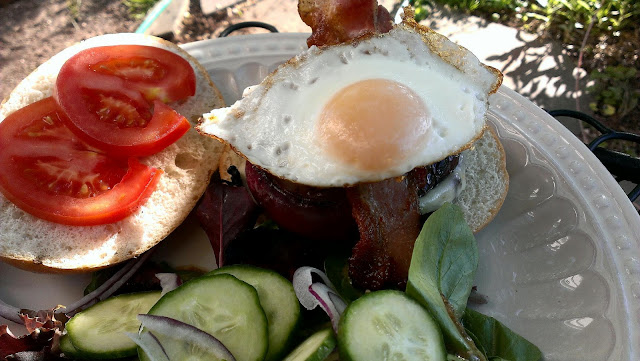
| Bacon and egg burger |
![]() |
| Tiny Silkie egg and goat cheese on homemade toasted bread; breakfast of champions! |
Tuesday, May 14, 2013
The Hops Have Arrived
I like beer and I like plants, so it just seems natural to try to grow some hops, right? Although we haven't tried to brew our own beer, we have friends that do, and at the very least the vines make pretty dried decoration. My grandfather, knows his stuff, and assured me that growing hops is very easy, and that the vine will grow as tall as you let it in the summer. So we've decided to to give it a try and see what happens!
We pre-ordered our rhizomes from Keystone Home Brewing. Rhizomes are the little root bit of the plant that you bury. We were recommended to buy two plants of the same variety. So we got three varieties, two each: Cascade, Columbus, and Mt. Hood.
They look sort of sad. The Columbus had a bit of mold on it, but from what I gather it'll grow just fine in properly drained soil.
The Columbus hops are a good dual purpose hop for both bitterness and strong aroma, perfect for pale ales and IPAs. Named after the Cascade mountains in Northwest US, these hops are the most widely used variety by craft breweries in the States. They have a medium strength aroma, spicy and citrusy.
The Mt. Hood's low acidity makes it primarily used for aroma. It's a descendant of the German Hallertau.
We'd love to build a trellis behind the raised beds, but for now they're just going in the ground. We dug holes for each rhizome, laid them in and covered them with some potting soil. We arranged them in three pairs, 4 foot apart, alphabetically, so I'd remember what's what.
Once they start growing we can stake them and maybe think about building a trellis. I'll let you know when we see something! So, I just found this photo on Monday Night Brewing. This is exactly what we had in mind, the fence even looks the same...
UPDATE: As of 6/13/13 still no signs of emerging hops. I'm not sure if we did something wrong or if I'm not being patient enough...
They look sort of sad. The Columbus had a bit of mold on it, but from what I gather it'll grow just fine in properly drained soil.
The Columbus hops are a good dual purpose hop for both bitterness and strong aroma, perfect for pale ales and IPAs. Named after the Cascade mountains in Northwest US, these hops are the most widely used variety by craft breweries in the States. They have a medium strength aroma, spicy and citrusy.
The Mt. Hood's low acidity makes it primarily used for aroma. It's a descendant of the German Hallertau.
We'd love to build a trellis behind the raised beds, but for now they're just going in the ground. We dug holes for each rhizome, laid them in and covered them with some potting soil. We arranged them in three pairs, 4 foot apart, alphabetically, so I'd remember what's what.
Once they start growing we can stake them and maybe think about building a trellis. I'll let you know when we see something! So, I just found this photo on Monday Night Brewing. This is exactly what we had in mind, the fence even looks the same...
UPDATE: As of 6/13/13 still no signs of emerging hops. I'm not sure if we did something wrong or if I'm not being patient enough...
Monday, May 6, 2013
Two Weeks With Chickens: What I've Learned About Our Flock
It's been two weeks since we've built our coop and let our chickens free to roam the 60 sqft run outside. Because neither of us have had chickens before we've been learning a lot of new things...
1. They really are easy to take care of. I let them out in the morning after my walk with Dante before work. Chris puts them to bed when he takes Dante out for his last pee of the day. So they've folded into our schedule nicely. I'd say they require no more than 2 hours of hands on time a week.
2. They're truly are little garbage disposals. We've given them radish tops, zucchini ends, mustard greens, and papaya rinds. The papaya rinds were the favorite by far. One would steal it and play keep away until another snatched it away.
3. They are pretty quiet. I was worried that we may annoy the neighbors, but they don't make any more noise than the other birds in the neighborhood. We do have three roosters but they haven't started to crow yet...
4. I'm not sad about the idea of giving them away. I thought I might become really attached to them, but the thought of giving the roosters away doesn't bother me. Or the thought of taking them to the butcher to "prepare" doesn't make me flinch either. Maybe I will make a good suburban farmer! We'll be taking them to a small animal auction this weekend in hopes to trade for some more hens.
5. Monica is the friendliest. She's our only Speckled Sussex hen, and she is definitively the most calm and easy to handle.
6. They can fly better than I expected. I was under the assumption that chickens can't fly other than a small hopping flutter, but sometimes when they exit the coop they bypass the ramp altogether and float down to the run. I've also seen Phoebe jump/fly at the run door. Real life Chicken Run.
7. They drink a lot of water. They go through the 2 gallon water feeder much faster than the food. They also go to the water first thing in the morning when I let them out. I think I'll add another water feeder in the summer.
8. They don't put themselves to bed yet. We were told that the chickens will learn to go into their coop at night, but they haven't figured out that one yet. Chris herds them up the ramp into the coop every night. He tries different methods: putting the roosters in and seeing if the hens will follow, putting them on the ramp to see if they'll march in. Eventually when the nights are warm enough, we'll just leave the door open to make them learn to go in by themselves.
9. They like to sun themselves. Their coop is completely covered with metal roofing, but the sun can still peep through in spots. Sometimes we'll find them literally stretched out on their sides sunning themselves.
10. They act like a pack of Velociraptors. Chris mentioned it and now I can't stop seeing them this way. It is said that chickens are the closet living relative to Velociraptors. If you watch how they move and interact together, and how their little heads turn to look at you, it's like you're watching Jurassic Park.
![]() |
2. They're truly are little garbage disposals. We've given them radish tops, zucchini ends, mustard greens, and papaya rinds. The papaya rinds were the favorite by far. One would steal it and play keep away until another snatched it away.
3. They are pretty quiet. I was worried that we may annoy the neighbors, but they don't make any more noise than the other birds in the neighborhood. We do have three roosters but they haven't started to crow yet...
4. I'm not sad about the idea of giving them away. I thought I might become really attached to them, but the thought of giving the roosters away doesn't bother me. Or the thought of taking them to the butcher to "prepare" doesn't make me flinch either. Maybe I will make a good suburban farmer! We'll be taking them to a small animal auction this weekend in hopes to trade for some more hens.
5. Monica is the friendliest. She's our only Speckled Sussex hen, and she is definitively the most calm and easy to handle.
6. They can fly better than I expected. I was under the assumption that chickens can't fly other than a small hopping flutter, but sometimes when they exit the coop they bypass the ramp altogether and float down to the run. I've also seen Phoebe jump/fly at the run door. Real life Chicken Run.
7. They drink a lot of water. They go through the 2 gallon water feeder much faster than the food. They also go to the water first thing in the morning when I let them out. I think I'll add another water feeder in the summer.
8. They don't put themselves to bed yet. We were told that the chickens will learn to go into their coop at night, but they haven't figured out that one yet. Chris herds them up the ramp into the coop every night. He tries different methods: putting the roosters in and seeing if the hens will follow, putting them on the ramp to see if they'll march in. Eventually when the nights are warm enough, we'll just leave the door open to make them learn to go in by themselves.
9. They like to sun themselves. Their coop is completely covered with metal roofing, but the sun can still peep through in spots. Sometimes we'll find them literally stretched out on their sides sunning themselves.
10. They act like a pack of Velociraptors. Chris mentioned it and now I can't stop seeing them this way. It is said that chickens are the closet living relative to Velociraptors. If you watch how they move and interact together, and how their little heads turn to look at you, it's like you're watching Jurassic Park.
Monday, April 29, 2013
Party Planning: A Weekend in Food & Drink
I'm a planner by nature. And as much as I'd love to throw a party and not think about it too far in advance, I can't. Next weekend we're having a Cinco de Mayo/ Dante's birthday party (an excuse for a fiesta). So this past weekend was spent prepping outside, shopping and making some food in advance. Norristown has a lot of Mexican shops and produce stores where you can get things that aren't available in the supermarket regularly, or at all. We had fun picking out some special things like piñata candy, and fresh poblanos for the party.
For me, prepping food a week before is a time and stress saver. I've started with salsa verde and roja, mini cornbread, and Cilantro syrup for drinks. I also tested a jicama seasoning and the "new to us" gas grill we found on Craigslist. As the week progresses I'll be posting some recipes!
![]() |
| Salsa Verde and sliced jicama |
![]() |
| Cilantro Limeade |
![]() |
| Chris supplies music while I do the grilling. Brought to you by Sly Fox Beer. |
![]() |
| The grill works! Kielbasa, onions and homemade spicy whiskey mustard. |
![]() |
| Piñata Candy |
UPDATE 05/07/2013: Emily took some awesome photos at the party, take a look here!
Subscribe to:
Posts (Atom)